WHAT IS PRESENT CONTINUOUS PASSIVE VOICE?
Table of Contents
What is continuous passive voice? Before going forward you have to understand the difference between active and passive voice forms of continuous Tense. Consider the below example
- He is doing his work Active Voice
- The work is being done Passive Voice
The above two examples make a clear difference between the two sentences. In the first sentence. We are talking about Active from of the Continuous Tense. While in the second example we are talking about passive form.
STRUCTURE OF ACTIVE AND PASSIVE VOICE CONTINOUS
| SENTENCE STRUCTURE | ACTIVE VOICE | PASSIVE VOICE |
| SUBJECT | He | No subject |
| OBJECT | work | work |
| Form of Verb | Do+ing = doing | Done (Third form of the verb) |
| Affirmative Form | Use this one Object + am / is / are + 1st form of verb +ing | Use this one Object + am / is / are + being + verb3 |
| Question Form | you should use, are / Am/ is + subject ++ 1st form of verb +ing + object | you should use, are / Am/ is + Object + being + verb3 |
IMPORTANT NOTE
- In the active form of continues Tense, we will use the first form of the verb + ing.
- On the other hand under the passive Voice form of Continuous Tense, we will use the being + third form of the verb.
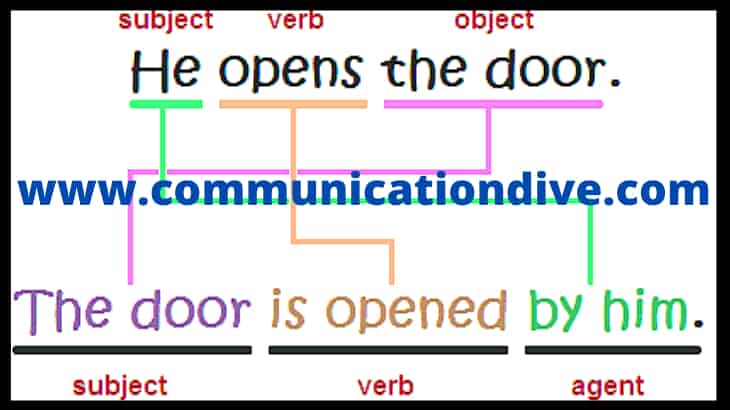
- Actually, Under Passive Tense we do not have a subject. Our primary focus will be on Objects.
- It means there is an object But no Subject.
- For example. We do not know How is doing the work?. The subject is unknown to us. For more info, You should visit this article. Difference between active and passive voice.
- Some time Subject is known to us, but he is doing work on the object directly. So under this situation, we will use the By For example
This work is done by him
As you noticed in the above discussion, there is no subject in passive form. More examples are below
| Sr# | ACTIVE VOICE | PASSIVE VOICE |
| 1 | The teacher is delivering the lecture | The lecture is being delivered by the teacher |
| 2 | They are measuring the room. | Room is being measured by them |
| 3 | He is reading this book | A book is being read by him |
| 4 | He is washing the clothes | Clothes are being washed by her. |
| 5 | Are they going to school? | Are they being gone to school? |
| 6 | They are singing a song | A song is being sung by them |
| 7 | He was eating the sugar | Sugar was being eaten by him |
| 8 | The sung is rising | Sun is being raised |
| 9 | You are making furniture | Furniture is being made. |
USE OF HELPING VERB IN A SPECIFIC TNESE
Now, the question is why we use the helping verbs in a given sentence? The answer to this question is very simple and easy to understand. Every tense has its own specification and structure. There is a structural difference between Indefinite, continuous, perfect, and perfect continuous tense. Let,s define a clear difference among them.
HELPING VERB IN INDIFENFTE TENSE
So if we talk about the indefinite Tense, We will use the first form of the verb + es or s. To fully understand the Structure of the indefinite tense you can visit this article. WHAT IS PRESENT INDEFINITE TENSE
CONTINUOUS TENSE AND HELPING VERBS
If we talk about the Continuous tense, we will use the is, are, and am depending upon the first, second, and third person. Please visit this article to get deep dive into WHAT IS CONTINUOUS TENSE.
HEPING VERBS USE UNDER PERFECT TENSE
As for as perfect Tense is concerned, we will use has and have with the third form of the verb. There is a complete article on Perfect Tense. You should visit this also. WHAT IS PERFECT TENSE?
USE OF HELPING VERB IN PERFECT CONTINUOUS TENSE
Now we will talk about Perfect Continuous Tense. In Perfect Continuous Tense, we will use the following helping verbs HAS BEEN and HAVE BEEM with the time period conditions such SINCE AND FOR. We have written a detailed article about PERFECT CONTINUOUS TENSE.