WHAT IS SIMPLE PASSIVE VOICE WITH EXAMPLES
Table of Contents
In this article, We are going to discuss the Simple Passive Voice Tense. Before moving forward you have to understand the clear distinction between active and passive voice Tenses so that you may comprehend this article easily. In this regard, you can visit this article to get a deep insight. Difference Between Active and Passive Voice. Simple Passive voice tense is not much difficult to Understand. You have to just inculcate some rules that will be given in this article. Inculcating these rules, you will be able to recognize the tense structure. So let’s start it.
STRUCTURE OF SIMPLE PASSIVE VOICE
There is a sharp difference between Indefinite Tense and simple passive voice. In simple passive Tenses, we will use Is, are, am helping verbs with the third form of the verb. On the other hand, these helping verbs are used in Present Continues Tenses with firest form+ing. Consider the example below:
| DIFFERENCES BETWEEN ACTIVE AND PASSIVE VOICE | ||
| Sr. No | PASSIVE VOICE | ACTIVE VOICE |
| 1 | We are punished | Teacher Punish the students |
| 2 | This work is done | Do this work |
| 3 | The patient is taken the medicine | The patient takes the tea |
| 4 | Your house is demolished | Your house demolish |
| 5 | The starts are not seen in the sky | They do not see the start in the sky |
| 6 | Wheat is sown in the winter | They sow the wheat in the winter |
| 7 | The thief is caught | He catches the thief |
| 8 | Are the mango eaten | Does he eat mangoes |
EXPLANATION FOR ABOVE TABLE
- In the above table, we explain both Tenses
- In the Passive Voice tense, it is not confirmed who performs the action.
- It means there is no clue about the subject Only the work is done upon an object.
- So under this circumstance when there is no subject, we will treat this tense in the passive voice category without any hesitation. More explanation is given below

USE OF PASSIVE VOICE
To explain an action we use Passive Voice instead of Active Voice. Because under it, our concern will be for Actions in a specific sentence. It does not matter who performs this action. Let,s take an example.
He does this work Active Voice
This work is done
- In the above example, He is a subject and he performs some action something such as do work.
- On the other hand, under the present simple passive voice, there is no mention of the subject.
- Just an action is taken place such as work is done. we do not know who does this work. So when the subject will be unknown to us, we will use simple passive voice tense
MORE USAGE
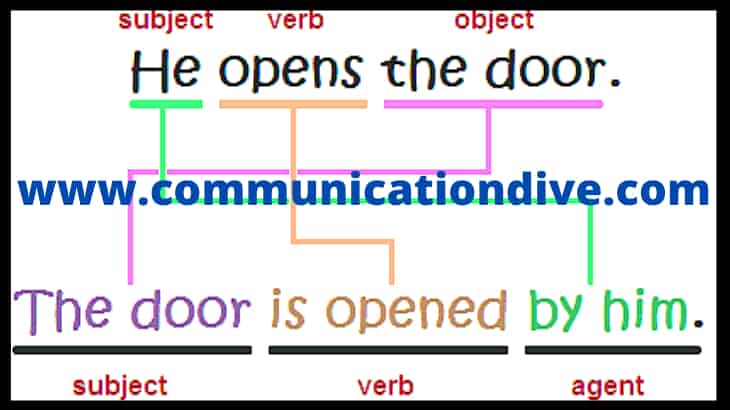
We can also use both subject and object in this tense. To form a relation between subject and object we will use By. Every noun or subject that is followed by is called an agent noun.
Alice washes the car Active Voice
Car is washed by Alice
So consider the above examples. In the active voice, the word they were the subject of the tense. Now under the second sentence by Alice is an agent Noun.
PASSIVE VOICE USES IN DIFFERENT SITUATIONS
There are other uses. Sometimes we use this tense for different purposes to make a sentence more beautiful and attractive. So we do not use by as an agent noun. To make clear about it, you can consider the following examples.
Quality garments are made in Pakistan.
In the above example, you have just skipped the By with Pakistan, Because it is not important and unnecessary to use.
POINTS THAT SHOULD BE REMEMBERED
We Use this Tense under the following conditions as well. When we talk about the directions and instructions for examples
| 1 | This work should be done on time. | Direction |
| 2 | This road is linked with China. | Instructions |
Furthermore, we will use this tense in the following situation. It will be used with Art, Science and literature take these examples
| 1 | All scientific methods are used to make experiments more durables | Science |
CONCLUSION
To sum up the discussion it is now clear that you shall use this tense when the subject is unknown. We will use this tense to define the action without the subject. In this regard, we will use be form such as is, are, and am with Past Participle i.e the third form of the verb.